
Learn how a 721 UPREIT works, how it differs from a 1031 exchange, and what investors should know about taxes, liquidity, and risk.
A 721 UPREIT transaction allows a property owner to contribute real estate to a real estate investment trust's operating partnership in exchange for partnership units. If the contribution meets the applicable requirements, Section 721 generally allows gain to be deferred rather than recognized at the time of the contribution.
For investors considering a move away from managing property, this structure offers a different form of ownership and a different set of risks. Horizon1031 helps investors evaluate real estate investment options in the context of their goals.
Key Takeaways: 721 UPREITs
- An UPREIT holds real estate through an operating partnership, which can accept property contributions in exchange for partnership units.
- Section 721 generally provides tax deferral for qualifying contributions, but debt, cash received, and other circumstances can change the result.
- Operating partnership units are partnership interests, not direct real estate, and generally cannot be used in a subsequent 1031 exchange.
- A 721 transaction can offer passive portfolio exposure, but investors should weigh liquidity limits, fees, loss of control, and investment risk.
- Horizon1031 helps investors review real estate options; independent tax and legal advisors can assess the consequences of a specific transaction.
How Does a 721 UPREIT Work?
UPREIT stands for umbrella partnership real estate investment trust. In this structure, the REIT owns an interest in an operating partnership that holds real estate. A property owner may contribute an accepted property to that partnership and receive operating partnership units, often called OP units.
Under Section 721, a qualifying contribution of property in exchange for a partnership interest generally does not trigger immediate recognition of gain. The statute has exceptions, and the details of a transaction matter.
A Simplified Example
Suppose an investor contributes a debt-free property worth $2 million with an adjusted tax basis of $500,000 and receives $2 million in OP units. Assuming the transaction qualifies and no cash or other taxable consideration is received, the $1.5 million built-in gain is generally deferred at contribution.
This illustration excludes fees and other complications. A later taxable disposition of the units, or a taxable sale of the contributed property by the partnership, may cause gain to be recognized.
What Do OP Units Represent?
OP units are interests in the operating partnership, not shares of the REIT itself. Their economic rights, distribution terms, transfer restrictions, and potential redemption or conversion rights depend on the partnership agreement.
Some units may be redeemable for cash or convertible into REIT shares under the offering's terms. Conversion or redemption is generally taxable, and a redemption right does not necessarily provide immediate liquidity.
How Does a 721 Differ From a 1031 Exchange?
A 1031 exchange generally involves qualifying real property exchanged for other qualifying real property. A 721 contribution transfers property to a partnership in return for a partnership interest. An investor generally cannot exchange real estate directly for OP units or REIT shares under Section 1031.
A deferred 1031 exchange has identification and acquisition deadlines. A standalone 721 contribution is governed by different rules, although its own agreement and due diligence will determine its timing.
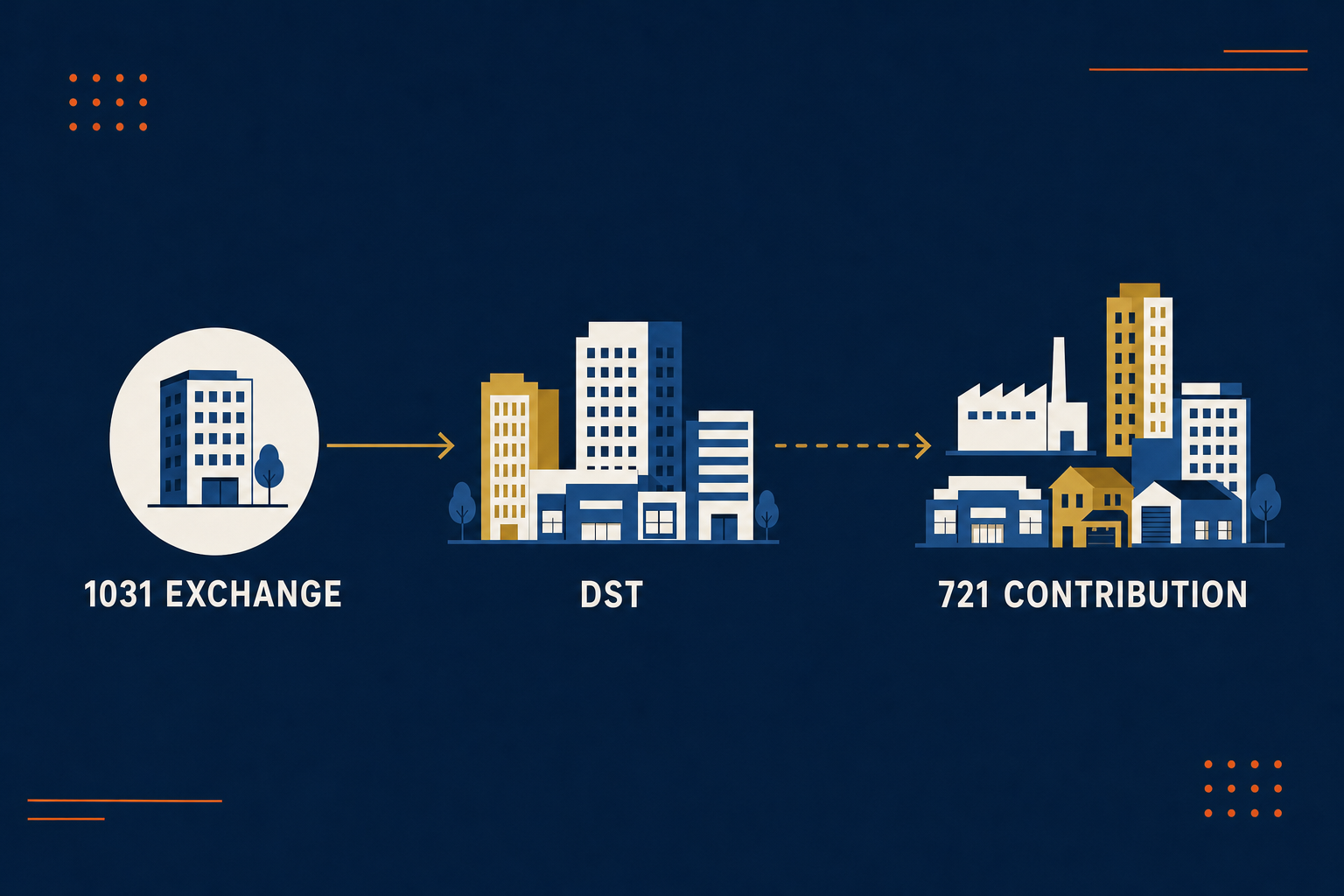
A Possible 1031-to-DST-to-721 Path
An investor may first complete a 1031 exchange into an eligible Delaware statutory trust (DST). Later, depending on the offering and transaction terms, the DST property or interests may be contributed to an operating partnership in a transaction intended to qualify under Section 721.
This second step is not automatic or assured. The sponsor's rights, the proposed structure, and tax treatment require careful review. Horizon1031 helps investors evaluate DST investments and their associated trade-offs.
Potential Benefits and Investment Risks
A 721 contribution may offer passive exposure to a portfolio of properties and defer recognition of gain at contribution. Diversification depends on the actual portfolio and does not prevent investment losses.
In exchange, you give up direct control over the contributed property. OP units may be difficult to sell, distributions can change, fees reduce returns, and the value of your investment can decline. Review the offering documents rather than assuming a particular exit or distribution.
Tax Considerations and Exit Options
Tax deferral is not necessarily permanent. A taxable redemption or conversion of units may trigger gain, and a partnership's sale of contributed property may allocate taxable gain to the contributing partner even while that partner still holds units.
Cash received, debt relief, changes in partnership liabilities, or disguised-sale rules can also affect the tax outcome. Partnership income may be taxable even if cash distributions are insufficient to cover the tax. Ask your CPA to model the transaction and ongoing reporting.
Because OP units are partnership interests rather than like-kind real property, you generally cannot exchange them for another property under Section 1031. A basis adjustment at death may be available under applicable law, but estate and partnership tax consequences depend on the facts.
Questions to Ask Before a 721 Contribution
Review the partnership agreement and offering documents with your attorney, tax advisor, and investment professional. Focus on the REIT's holdings, sponsor, valuation, fees, restrictions, redemption rights, and any tax-protection provisions.
For a DST pathway, ask who controls a potential contribution, whether you can choose another exit, and what happens if the transaction does not occur. Horizon1031's discussion of DST due diligence describes areas to examine when considering an offering.
Is a 721 UPREIT Right for You?
A 721 UPREIT may be worth considering if you seek passive real estate exposure and are comfortable trading direct control and future 1031 flexibility for a partnership interest. The suitability of any transaction depends on the investment, your liquidity needs, and your tax circumstances.
Consult your own tax and legal advisors before committing. This article is educational and is not tax, legal, or investment advice.
FAQs About 721 UPREITs
Are a 721 UPREIT and a 1031 exchange the same?
No. A 1031 exchange generally swaps qualifying real property for qualifying real property. A 721 transaction generally contributes property to a partnership in exchange for a partnership interest. The two can be separate stages in a proposed strategy.
Will every DST eventually convert to OP units?
No. A 721 transaction depends on the DST and REIT structure, the governing documents, and the parties' decisions. Review the offering's specific exit provisions before investing.
Are OP unit distributions guaranteed?
No. Distributions depend on the partnership and its governing terms and may change. Review the offering documents and consider the possibility of taxable income without sufficient cash distributions.